

|
Getting your Trinity Audio player ready...
|
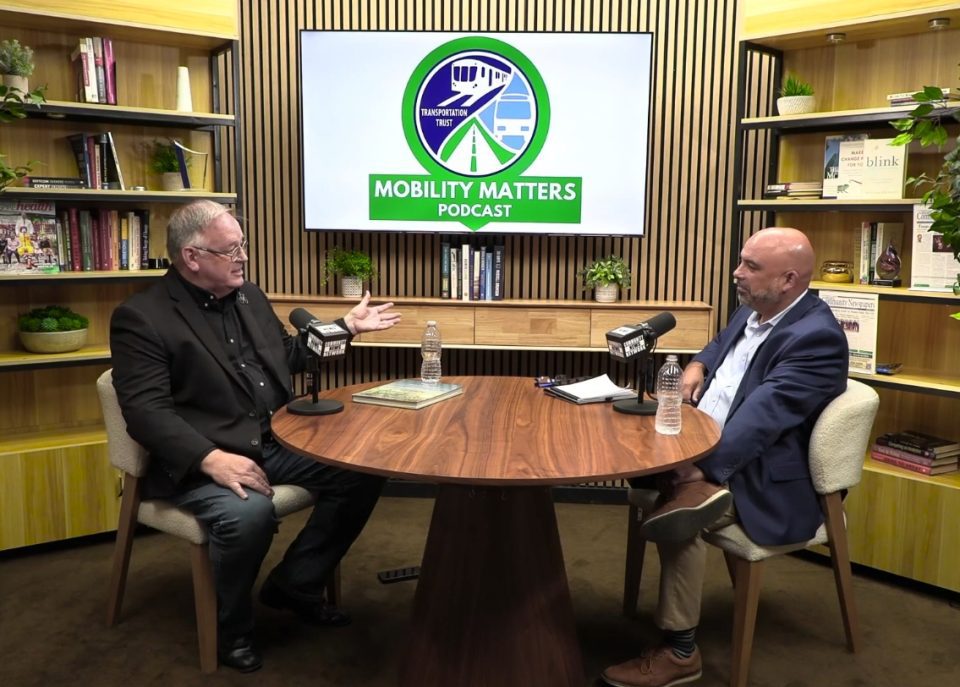
On a recent episode of Mobility Matters, I had the privilege of welcoming Victor Dover, founding principal of Dover, Kohl & Partners, and one of the most respected urban planners and designers of our time.
I’ve known Victor for decades, and every time we speak, I’m reminded of how fortunate we are to have world-class thinkers and doers right here in our own backyard. Miami is home to some of the brightest minds in urbanism, architecture, and mobility, yet people often take for granted that so many of the most renown leaders shaping global conversation live just a few miles away.
Victor describes his work as this: helping communities imagine what they want to become when they grow up.
With his team, he travels across the country guiding cities on how to design safer streets, build better neighborhoods, and create places where people genuinely want to live, work, and connect. And much of that work begins with a fundamental idea: cities were invented to bring people closer together and not farther apart.
We talked about the origins of the new urbanism movement, much of which grew out of the University of Miami’s School of Architecture. Designers like Andrés Duany and Elizabeth Plater-Zyberk helped define a philosophy centered on compact, connected, walkable communities.
The goal is not just aesthetic, it’s deeply practical. When daily destinations are close at hand, and streets are designed for people, everything becomes safer, healthier, and more economically resilient.
Victor and I also tackled a topic that affects every resident in Miami-Dade: speed. The reality is simple: speed kills. A pedestrian struck at 20 miles per hour faces a 5% chance of death. At 40 miles per hour, that jumps to nearly 80%.
The solution, as Victor points out, isn’t more signage or harsher enforcement. It’s a better street design. Narrower lanes, tree canopies, shorter blocks, active frontages, and human-scaled environments naturally slow drivers without them even thinking about it. And when we create streets that feel comfortable for walking or biking, people start choosing those modes, often replacing the short, routine trips that make up the majority of our daily travel.
We also discussed the changing culture around driving. Younger generations don’t see cars as symbols of freedom; they see them as burdens. Parking, gas, insurance, stress, and congestion all add up. As Victor put it, more and more people want to “have a life” not just sit in traffic.
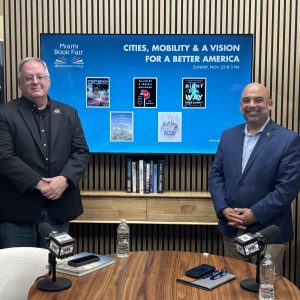
These issues were front and center in an author panel titled “Cities, Mobility and a Vision for a Better America” that Victor and I organized for this past November’s Miami Book Fair which featured prominent thought leaders in placemaking, street design and mobility. During the panel, the authors – Victor Dover, FAICP, author of “Street Design: Secrets to Great Cities and Towns”; Wes Marshall, Ph.D., P.E., author of “Killed by a Traffic Engineer: Shattering the Delusion that Science Underlies our Transportation System”; Angie Schmitt, author of “Right of Way: Race, Class and the Silent Epidemic of Pedestrian Deaths in America”; Charles Bohl, Ph.D., author of “The Art of the New Urbanism”; and Juan Mullerat, author of “The Urban Calendar: 365 Days That Shaped the Urban World” – engaged in a thoughtful and informative discussion on how to design cities and streets that truly work for everyone.
As always, I’m grateful for voices like theirs that push us to see mobility as more than engineering; it’s about community, wellbeing, and how we choose to live together. If you’ve ever wondered why your neighborhood looks the way it does, or how we can build safer streets for our families, this is a conversation worth hearing.
To learn more about the CITT and how your half-penny surtax supports mobility across Miami-Dade, visit miamidade.gov/CITT. And if you’d like to get involved as a Board Member or Ambassador, we’d love to have you join us.
To view the full interview with Victor Dover, and other past Mobility Matters podcast recordings, visit our YouTube channel @TransportationTrust. Here you can also view a recording of the Miami Book Fair panel discussion titled “CITT-Sponsored Author Panel at the 2025 Miami Book Fair.”
We want to thank Miami’s Community Newspapers (MCN) for their continued partnership in producing our bi-weekly Mobility Matters podcast, which airs live on MCN’s network every other Thursday starting at 9:30 a.m.